
Research Report: The Hidden Lives of Farmed Animals at the Intersection of Agriculture and Experimentation
Investigation reveals nearly 100,000 farmed animals used annually in agricultural experimentation and teaching at just ten U.S. universities, with little external animal welfare oversight. Read the full report here.
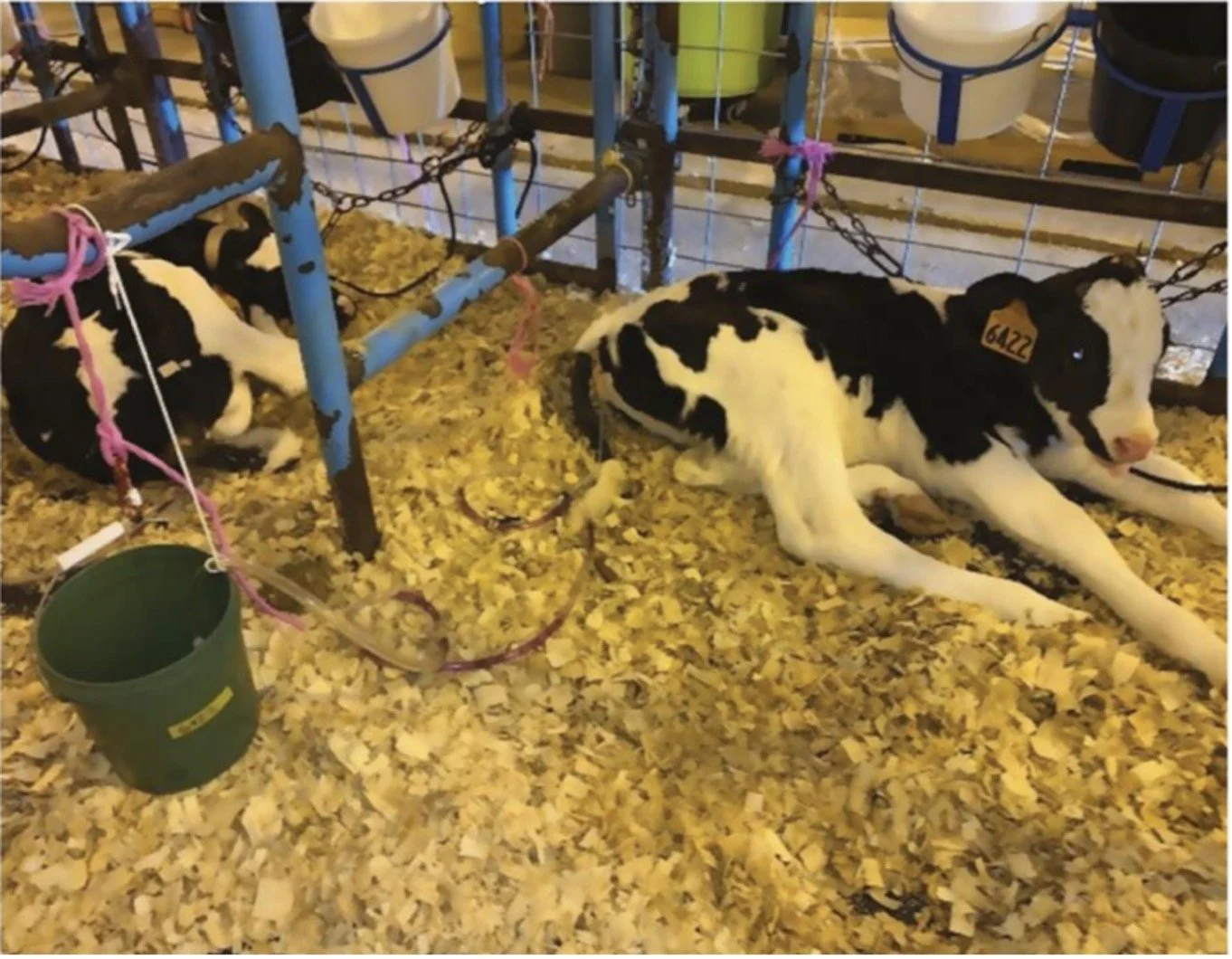
Calves, chained to metal stalls at Purdue’s ASREC Dairy Farm, having their urine collected via catheterization as part of an experimental protocol. Adapted from Ceja et al., https://pmc.ncbi.nlm.nih.gov/articles/PMC9387597/. Part of the U.S. Public Domain.
September 23, 2026
When most people picture animal experimentation, they imagine dogs or primates in laboratory cages—not cows, pigs, and chickens on a university farm. But farmed animals are used extensively in agricultural research at universities throughout the country, often with less external oversight and public visibility than other categories of animal experimentation in the United States.
On September 23, 2026, Animal Partisan released "The Worst of Both Worlds: The Hidden Lives of Farmed Animals at the Intersection of Agriculture and Experimentation," an investigative report into this secluded experimental sector. This report was built entirely on public records obtained in collaboration with Rise For Animals from ten public universities across the country.
The Animal Welfare Act excludes farmed animals used in agricultural research, which means their numbers, treatment, and fate are absent from federal reporting. But public universities that voluntarily accredit their agricultural programs with AAALAC International generate consolidated records that can be obtained through public records requests. We requested and analyzed those records from ten AAALAC-accredited public universities, opening a rare window into a sector of experimentation that normally stays hidden.
Our key findings:
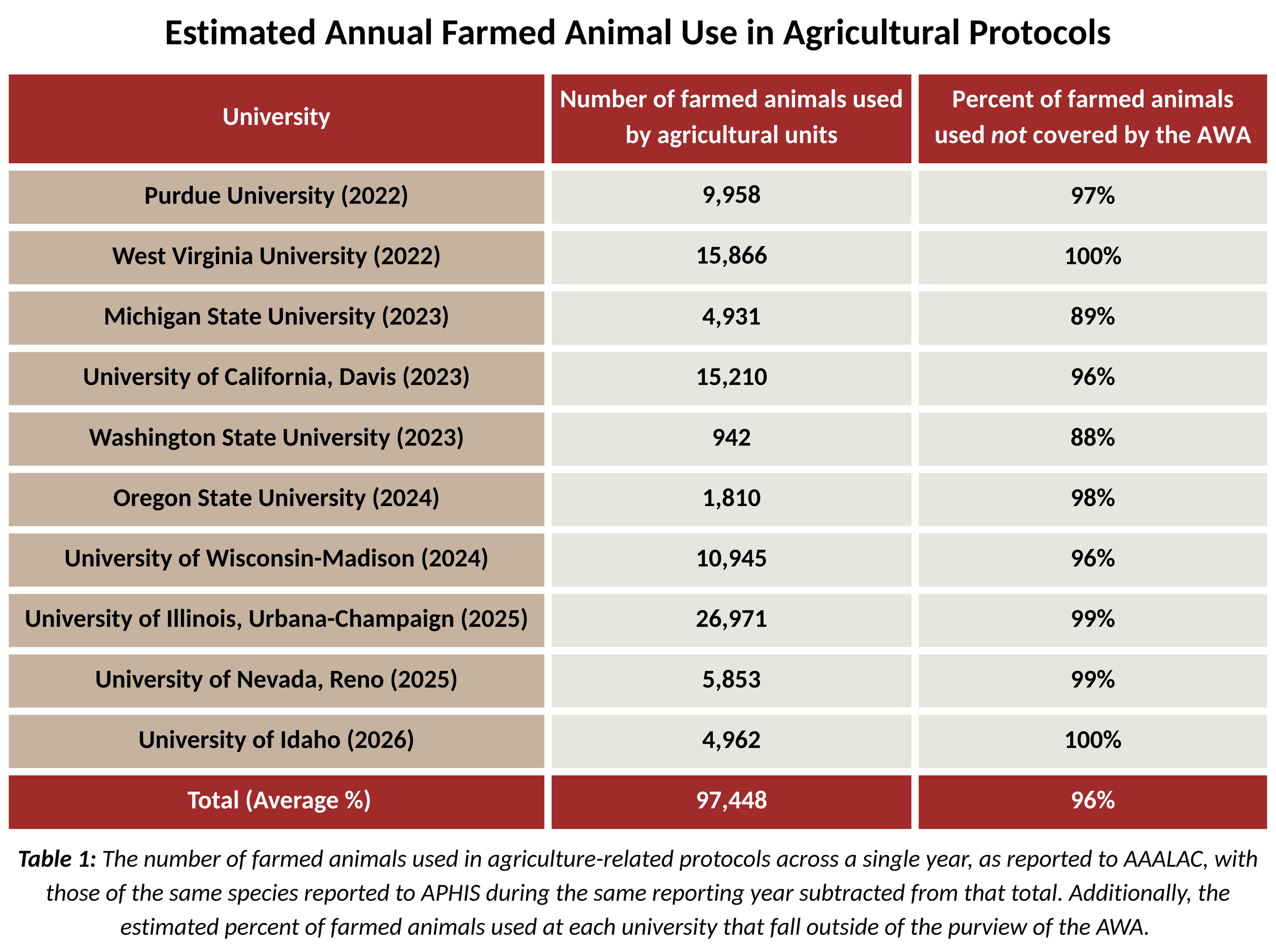
Significant scale: At just these ten institutions, an estimated 97,448 farmed animals were used in agricultural experimentation, teaching, and commercial production in a single year — and an average of 96% of all farmed animals used in university protocols fall entirely outside the Animal Welfare Act's already minimal protections. While this population is of course just a small fraction of all the animals born into the animal agriculture industry, it is important to remember that the farmed animals discussed in this report are additionally burdened with the purpose of providing data to uphold, promote, and expand this industry—while essentially living the same lives as their counterparts on “conventional” factory farms when not assigned to experimental protocols.
Oversight gaps: The Animal Welfare Act excludes farmed animals when used for agricultural experimentation outright. NIH oversight applies mainly to biomedical research, and AAALAC accreditation requires following the Ag Guide’s recommendations, although these are typically consistent with the standard agricultural practices seen on factory farms. State animal confinement bans commonly exempt "research." At every layer, the animals caught between agriculture and experimentation fall through the cracks.
Research, teaching, and commerce are inseparable: These animals live on working farms operated by the university, where a single animal may be a research subject, a teaching tool, and a commercial product at once: raised, experimented on—sometimes multiple times throughout their lives—often killed at the university's own slaughterhouses, and sold to the unsuspecting public under campus meat, dairy, and egg brands.
Substantially funded by taxpayers and industry money: The USDA's National Institute of Food and Agriculture (NIFA) and Agricultural Research Service (ARS) grant programs alone directed roughly $72.4 million in federal funding to nine of these institutions over five years. These grants sit atop significant funding from stakeholders in the animal agriculture industry and commodity-board grants, some of which are compelled by state law.
Routinely downplayed suffering: Experimental protocols involving induced heat stress, colostrum deprivation, and mass culling via ventilation shutdown were categorized as only "minimally painful or distressing” by researchers, likely because they mirror practices already considered "standard" in commercial animal agriculture.
Why this matters:
This report doesn't just add to the scale of animal experimentation advocates already track. It surfaces an entire category that has largely gone unnoticed, sitting at the intersection of two exploitative systems that have thus far been treated as functionally separate by the animal advocacy movement.
Recommendations for animal advocates:
Explore law and policy work. From petitions at the university level to federal law reform, this neglected sphere of animal suffering is rife with opportunities for law and policy work. Efforts to increase transparency around the sale of products from animals used in experiments may be particularly well-suited here, given that the FDA and USDA both give citizens the opportunity to submit rulemaking petitions directly to these agencies.
Fold into existing campaigns. Whatever focus your animal advocacy takes, the use of farmed animals in agricultural experimentation likely has significant overlap with current organization goals and campaigns. Consider incorporating this contingent of exploited animals into your current work when possible.
Talk to consumers. The meat, milk, and eggs sold under university brand names often come from the animals used in this experimentation, and it isn’t clear if consumers are aware of this—or if they would even be comfortable consuming these products had this been disclosed.
Engage with students. College students may be entirely unaware of the agricultural experimentation happening on their own campuses, and they could prove to be highly effective allies in the fight against this form of cruel experimentation.